How to Prioritize Your Wedding Budget: Getting What You Want Without Paying for What You Don’t
You and your partner are going to have a lot of conversations about money during this process, and that’s actually a good thing. Those conversations — sometimes a little uncomfortable, always clarifying — are what turn two individual sets of wishes into one shared set of priorities. The couples who have this conversation early and honestly tend to end up the happiest with how they spent their budget. The ones who skip it tend to end up wondering, a year later, why they spent so much on flowers they don’t even remember and so little on the photography they look at every day.
Here’s the framework we use with every couple to make that conversation easier.
The four levels, and the six categories
In the sample budgets we send to potential clients, we organize every option into four broad service levels: Lovely, Great, Fantastic, and Unforgettable. These aren’t rigid packages — they’re a shorthand for how elevated, elaborate, and produced any given element of your wedding can be. A “Lovely” florals package and an “Unforgettable” florals package both produce a beautiful wedding. They just produce very different beautiful weddings, at very different price points.
Your overall wedding budget breaks down into six major categories:
- Food
- Drinks
- Music, dancing, and entertainment
- Decoration, flowers, and lighting
- Photography, video, and content
- Venue
Here’s the exercise: for each of those six categories, ask yourselves one simple question. How do we want our guests to feel about this part of our wedding? Lovely? Great? Fantastic? Unforgettable? There’s no wrong answer, and your answer for each category doesn’t need to match the others. That’s the whole point.
What this actually looks like for a real couple
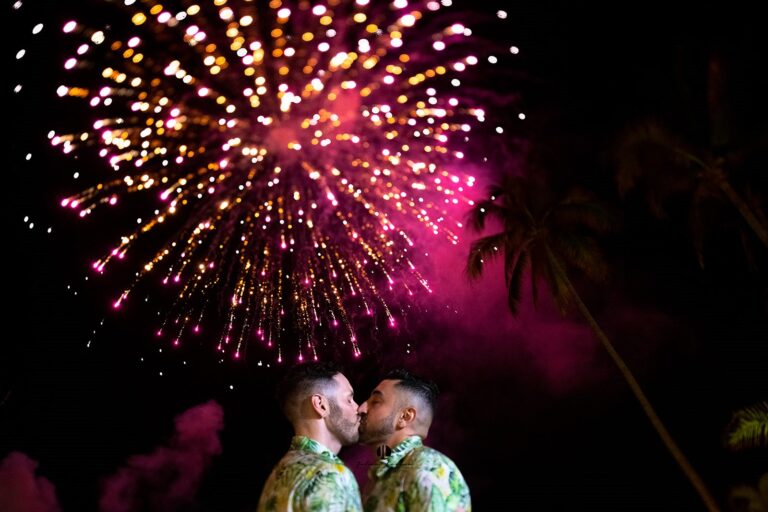
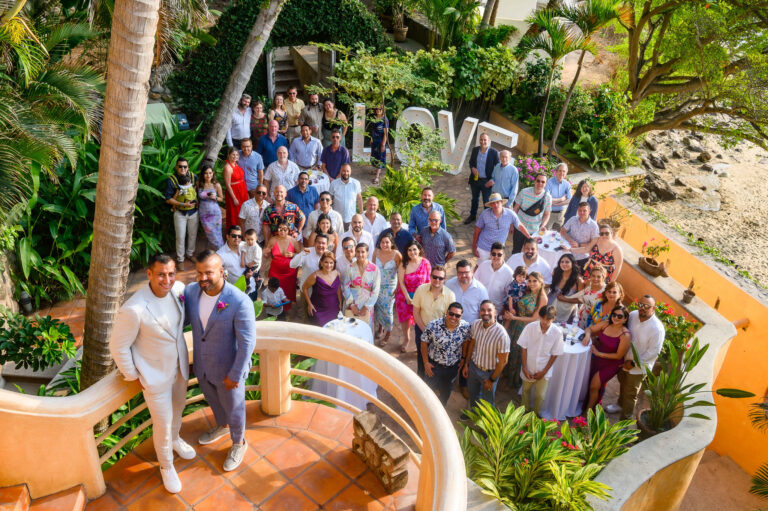
Take a hypothetical pair of grooms planning a 50-guest wedding. Photography is the thing they keep coming back to in every conversation: they’re both visual people, they want images they’ll frame and look at for decades, and neither of them is particularly interested in dancing all night. Food matters to them too; they grew up in food-obsessed families and want their wedding dinner to be genuinely memorable, not just adequate. Flowers, on the other hand, don’t move either of them much. They like the idea of a beautiful space, but neither has strong opinions about specific blooms.
Running through the six categories, their priorities might land like this: Photography and Video — Unforgettable. Food — Fantastic. Venue — Fantastic (because for them, the right venue does most of the decorative work on its own). Drinks — Great. Decoration and Flowers — Lovely. Music and Entertainment — Great.
What that produces is a wedding where the budget flows toward an exceptional photography and video package — full-day coverage, a second shooter, a beautifully edited highlight film — and a genuinely impressive catering experience, while the florals stay simple and elegant rather than elaborate, because that’s honestly not where this couple’s hearts are. Nobody at their wedding will walk away thinking the flowers were sparse. They’ll walk away remembering an incredible dinner and, a few months later, opening a wedding album they can’t stop looking at.
A different couple, planning a wedding at the same venue with the same budget, might flip nearly all of this: prioritizing a fully produced entertainment lineup and elaborate floral installations while keeping photography to a solid, professional, but less elaborate package. Both weddings are wonderful. Both are entirely appropriate uses of the same total budget. The difference is that both couples spent their money on what actually mattered to them, instead of distributing it evenly across six categories and ending up with a wedding that’s pretty good at everything and exceptional at nothing.
Spend on your priorities first
Once you’ve ranked your six categories, tackle them in that order. Lock in your top priority first and make sure you get exactly what you want there — that’s where the budget should go first, before anything else is finalized. The remaining categories still need to happen, and they’ll still be beautiful, but they don’t need your full attention or your full budget. Not everything has to be Unforgettable. Frankly, there are other things in life worth saving for — a down payment on a house is a perfectly reasonable thing to prioritize over an extra five thousand dollars in floral installations.
This is, honestly, one of the biggest advantages of planning an independent wedding at a private villa rather than a packaged wedding at a large resort. We don’t sell packages. You’re never paying for a bundled tier that includes things you don’t care about in order to access the one thing you do. Every dollar in your budget goes exactly where you want it to go, and nowhere else. For couples who want that level of control, it’s hard to go back to anything else once you’ve experienced it.
If you and your partner are having trouble agreeing on your six priorities, that disagreement is worth having out loud rather than avoiding: it usually reveals something useful about what each of you actually wants from the day, beyond just the wedding itself.
Ten ways to reduce costs without cutting your guest list
Prioritizing your budget is about spending well. These are about spending less, across the board, without touching the size or scope of your celebration.
- Build your wedding website using a free tool. Several platforms, including The Knot, offer free wedding website builders. There’s no reason to pay for this when a perfectly good free option exists.
- Use Wise for international money transfers. If you’re moving funds to Mexico (to your planner, to vendors, to cover deposits) Wise offers significantly better exchange rates and lower fees than a traditional bank wire.
- Combine lodging and venue where possible, and let your guests’ bookings work for you. This applies most directly to boutique hotel weddings rather than private villas: the more room-nights your guest block generates, the more leverage you have to negotiate perks, upgrades, and discounts with the property.
- Use a travel rewards credit card for wedding expenses. Put as much of your wedding spending as you reasonably can on a card that earns travel miles or points, then use those rewards to offset your own honeymoon or your guests’ travel costs.
- Stay at a private villa and keep a light hand on the household budget. With a private chef handling meals for your in-house guests, modestly managing the household grocery and bar budget can keep your per-guest costs to a fraction of what three restaurant meals a day would cost, without anyone feeling like they’re going without.
- Give your florist a budget ceiling, not a specific shopping list. Tell your florist the maximum you want to spend and trust their judgment on which specific blooms and foliage to use within that number. Skilled florists can produce a stunning design within almost any reasonable budget if they have the freedom to substitute intelligently.
- Ask your caterer to work within a firm per-person maximum. Experienced catering chefs are used to designing menus that hit a specific budget target without sacrificing quality. Give them the number and let them build around it.
- Offer a curated bar instead of a full open bar. Signature cocktails, beer, and wine cover the vast majority of what your guests actually want to drink, at a meaningfully lower cost than an unrestricted open bar with full liquor selection.
- Negotiate a full property buyout if you’re at a boutique hotel. Booking out an entire small property often unlocks discounted rates, complimentary upgrades, and other perks that aren’t available to a group booking only part of the hotel.
- Buy travel insurance that explicitly covers international wedding events. Most of your deposits — venue, catering, key vendors — will be non-refundable, and you’re likely committing tens of thousands of dollars before your wedding day arrives. A policy that genuinely covers event cancellation is inexpensive relative to what it protects.
Getting your budget right isn’t about spending less — it’s about spending intentionally. Couples who go through this exercise honestly tend to end up with weddings that feel unmistakably like them, rather than weddings that feel like an evenly distributed checklist.
If you’d like help working through this exercise for your own wedding, our free planning guide is the best place to start — it includes sample budgets at all four service levels.
Get your free planning guide →
Or reach us directly at info@mexicoeventdesign.com or (737) 212-2165.
Mexico Event Design is a gay-owned boutique wedding planning and design agency specializing in private villa LGBTQ+ destination weddings in Puerto Vallarta, Mexico. We plan a small number of weddings each season intentionally — so that every couple gets our full attention.