Legal vs. Spiritual Ceremonies for LGBTQ+ Couples in Puerto Vallarta: What You Need to Know
By Robert Schley, Mexico Event Design
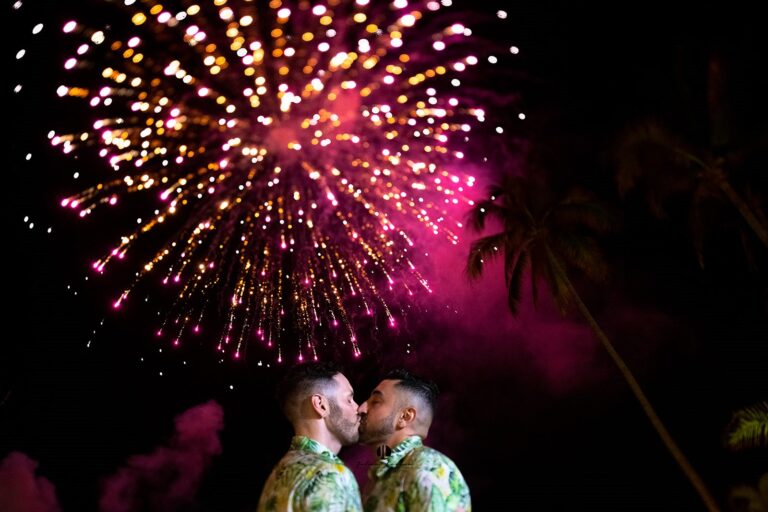
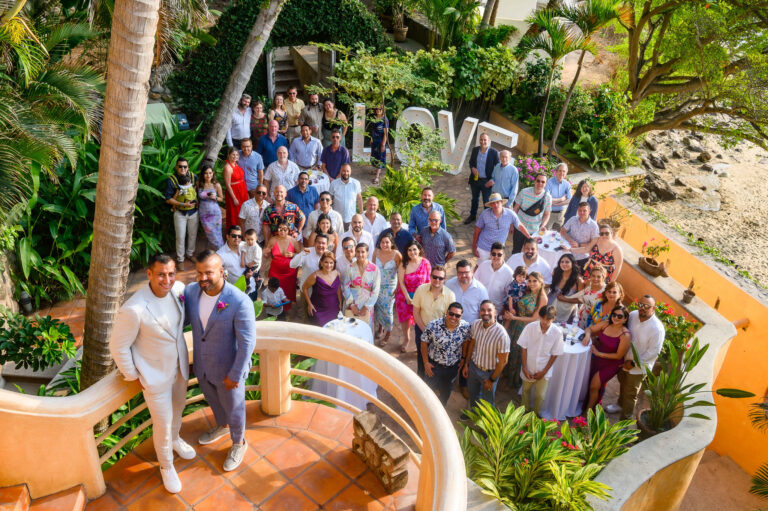
Let’s start with the most important thing: the vast majority of LGBTQ+ couples who come to Puerto Vallarta to get married are here for a spiritual ceremony and a party. They’re already legally married — or planning to get legally married — in their home jurisdiction. And honestly, that makes a lot of sense. Getting legally into a marriage is easier to handle at home. Getting legally out of one, if it ever comes to that, is easier at home too.
If that’s you, you can stop reading here. Enjoy the planning.
But if you find yourself in one of the scenarios below — or something like them — this post is for you. It’s an update to an article we first published in 2017, shortly after same-sex marriage became fully available throughout Jalisco and Nayarit. A lot has changed since then, including some important legal developments in Europe that affect couples from certain countries. We’ve also verified all the current requirements directly against the official 2024–2025 documentation from both the Puerto Vallarta Registro Civil and the State of Nayarit. Read on.
Two scenarios where a legal ceremony in Mexico makes sense
Scenario One: One of you is Mexican, and the other is from Denmark. You’re planning to live in Denmark and are interested in eventually establishing legal status in each other’s home countries. Getting legally married in Mexico establishes a marriage certificate that’s recognized internationally — and can be the foundation for residency and immigration applications in both countries.
Scenario Two: One of you is Polish and the other is Algerian. You met as students at a university in Mexico City. Neither of your home countries recognizes same-sex marriage. You want a legally valid document that says you’re married somewhere — even if it isn’t recognized everywhere you might live. The symbolic and practical value of that document is real, and Mexico is one of the more accessible places in the world to obtain it.
The honest overview: what you’re getting into
For Mexican citizens, the civil marriage requirements are straightforward. For foreign nationals — or a foreign person marrying a Mexican — there are additional steps: getting your home-country documents certified and authenticated for Mexico, then reversing that process to get your Mexican marriage certificate recognized back home. Each step costs money and takes time, and the whole process virtually guarantees you’ll need to arrive in Puerto Vallarta several days before your ceremony.
The good news: the requirements themselves are not complicated, and there are excellent local specialists who handle this process regularly. We’ll point you to them at the end.
Current legal requirements for Jalisco (Puerto Vallarta)
The following reflects the official requirements as published by the Puerto Vallarta Registro Civil in October 2024. Requirements for the Nayarit side of the region (Bahía de Banderas, Nuevo Vallarta) are noted separately where they differ.
1. Pre-marriage course at DIF.
Both partners must attend a pre-marital course offered by the local DIF office (Sistema Nacional para el Desarrollo Integral de la Familia). Sessions are held Thursday afternoons. You’ll receive a certificate to bring with your marriage application. DIF Puerto Vallarta: (322) 225-9936.
2. Certified birth certificates.
Certified copies of each partner’s birth certificate — issued no more than one year before the wedding date — plus two photocopies of each.
For Mexicans: certificates must be requested from the local Registro Civil in the state of origin.
For foreigners: birth certificates must be apostilled in your home country and then translated into Spanish by an officially authorized court translator (perito traductor) in Puerto Vallarta. If your home country’s official language isn’t Spanish, translate first into English before coming to Mexico, since very few certified local translators work in languages other than English and Spanish.
Important note for Canadians: Canada is not a signatory to the Hague Convention, which means the standard apostille process doesn’t apply. Instead, Canadian documents must be legalized through Global Affairs Canada and then through the nearest Mexican Consulate to your home. Plan additional time for this.
3. Medical certificate.
A certificate signed by a Mexican physician with a valid cédula profesional (professional license number), issued within 15 days of the wedding date.
4. Blood tests.
Clinical results confirming blood type and testing for both syphilis (VDRL) and HIV, also issued within 15 calendar days of the ceremony date. The results must include the physician’s signature and cédula profesional. These tests must be performed in Mexico — results from your home country are not accepted.
Note: The previous requirement for Mexican women to present a cartilla de salud (health card) is no longer listed in current official Puerto Vallarta documentation. If you are a Mexican citizen, confirm this with the Registro Civil directly, as local requirements occasionally vary from published lists.
5. Identification.
Copies of official photo identification for both partners and two witnesses — passport, Mexican INE card, or driver’s license — all on one letter-size page. For ceremonies held outside the Registro Civil offices (which most destination weddings are), four witnesses are required rather than two.
6. Legal partnership regime.
You’ll choose one of three options at the time of filing:
- Sociedad legal — the default; broadly equivalent to community property
- Sociedad conyugal — conjugal partnership; you specify which existing assets are shared and which remain separate, with all future assets presumed community property
- Separación de bienes — full asset separation; both partners keep their existing assets entirely separate
If you have significant assets and are choosing sociedad conyugal or separación de bienes, you may need to formalize the arrangement through a Notario Público (capitulaciones matrimoniales). If you have no prior assets, the Registro Civil can prepare a simple agreement.
7. Prior marriage documentation.
If either partner has been previously married, a certified copy of the divorce decree or death certificate of the prior spouse is required. For foreign documents, this must also be apostilled and translated following the same process as the birth certificate.
8. Marriage application (solicitud de matrimonio).
A formal petition to marry, signed by both partners and two witnesses, available from the Registro Civil. The application is then signed by the officiating judge during or immediately following the ceremony.
9. The marriage certificate and what comes next.
At the conclusion of the civil ceremony, the judge issues an official marriage certificate (acta de matrimonio). For this to be legally recognized in your home country, you’ll then need to reverse the process: get the Mexican certificate apostilled by the state government of Jalisco, have it translated by an officially recognized translator in your home country, and file it with the appropriate local authority.
10. Interpreter.
If either partner doesn’t speak fluent Spanish, an authorized interpreter should be present for each non-Spanish-speaking spouse, as the ceremony is conducted entirely in Spanish.
Differences in Nayarit (Bahía de Banderas / Nuevo Vallarta)
The Nayarit requirements are substantially similar to Jalisco’s, with the following differences:
The apostille is required for foreign documents in Nayarit — contrary to what we wrote in an earlier version of this article. Current official Nayarit state requirements confirm that foreign birth certificates must be apostilled or legalized according to your country’s procedures.
Nayarit requires four witnesses for all ceremonies — not just those held outside the Registro Civil — regardless of venue.
Nayarit’s medical certificate and blood tests must be obtained specifically from an official government health center (SSN Centro de Salud) rather than from any licensed private physician.
Nayarit offers only two partnership regime options — sociedad conyugal and separación de bienes — and does not use the sociedad legal classification.
Nayarit additionally requires a “constancia de no deudor alimentario moroso” — a certificate confirming that neither partner has unpaid court-ordered child support or alimony obligations. This document is not required in Jalisco.
Working through the scenarios
Scenario One: Mexican partner and Danish partner
The Mexican partner follows the standard Mexican national requirements above. The Danish partner needs to get their birth certificate apostilled by the Danish government, then have it translated into Spanish by an authorized Puerto Vallarta translator. Both partners attend the DIF pre-marital course and complete the blood tests within 15 days of the ceremony.
Following the ceremony, the Mexican marriage certificate needs to be apostilled by the Jalisco state government. Once apostilled, the certificate can be taken to Denmark and filed with the appropriate local authority — which should allow the Danish partner to begin the process of sponsoring the Mexican partner’s Danish residency. Simultaneously, the Danish partner may apply for temporary or permanent Mexican residency through the Instituto Nacional de Migración (INM).
Scenario Two: Polish partner and Algerian partner
Both partners follow the foreign national requirements above, with one difference: because Algeria is not a member of the Hague Convention, the Algerian partner’s birth certificate must be “legalized” through an alternative international process rather than apostilled. Your local specialist can advise on the specific steps.
An important update since we first published this article: in November 2025, the European Court of Justice issued a significant ruling requiring all EU member states to recognize same-sex marriages legally performed in other EU countries, specifically for the purposes of EU law rights — including residency and freedom of movement. While Poland has not domestically legalized same-sex marriage, this ruling may create a pathway for EU residency rights in certain circumstances. This area of law is still evolving. We strongly recommend consulting with an immigration lawyer in Poland before making plans based on this development — but it is a meaningful change from the situation as it existed when we first wrote about these scenarios.
In countries that don’t recognize same-sex marriage either legally or by treaty, a Mexican marriage certificate can still carry real practical value: employer benefit programs, private insurance and banking arrangements, and next-of-kin designations at financial institutions often operate on the couple’s own documentation rather than on state recognition.
One more option worth knowing about
Mexico City now permits “double-proxy” civil marriages — meaning neither partner needs to be physically present in Mexico for the legal ceremony to take place. This is not yet available in either Jalisco or Nayarit, but it could be worth exploring if your circumstances make travel difficult.
This is not legal advice
Everything in this article is based on our translation and interpretation of the official requirements published by the Registro Civil offices in Puerto Vallarta and Nayarit, updated as of 2024–2025, along with publicly available legal sources. We are wedding planners, not attorneys. Requirements can and do change, local officials sometimes interpret rules differently from published lists, and your specific situation — particularly if it involves prior marriages, complex nationality questions, or immigration goals — may involve considerations we haven’t addressed here. Please consult a qualified immigration lawyer and contact the local Registro Civil directly before scheduling your legal ceremony.
The specialists we trust for legal ceremonies
Two contacts we’ve worked with and recommend:
Patricia Monroy
www.legalceremoniespuertovallarta.com
(+52) 322-116-2930 (Phone/WhatsApp)
patricia.legaldocuments@gmail.com
Lic. Luis Fragoso
Identidad, Diversidad, Legalidad
www.idl.com.mx
(+52) 55-4444-3923
info@idl.com.mx
Whether you’re planning a legal ceremony, a spiritual celebration, or both, the best first step is our free planning guide — Before You Book Anything: Six Essential Truths About Planning Your LGBTQ+ Wedding in Puerto Vallarta. It covers venue selection, guest list strategy, timing, and what working with a local planner actually looks like.
Get your free guide and start planning →
Or reach us directly at info@mexicoeventdesign.com or (737) 212-2165.
Mexico Event Design is a gay-owned boutique wedding planning and design agency specializing in private villa LGBTQ+ destination weddings in Puerto Vallarta, Mexico. We plan a small number of weddings each season intentionally — so that every couple gets our full attention.